Introduction
Wild honey has been used as a part of our society for generations. References say that honey has been used in traditional medicine, such as Ayurveda and Siddha, for centuries. And traditional honey gathering continues to be a vital source of livelihood for tribal groups throughout India and Nepal.
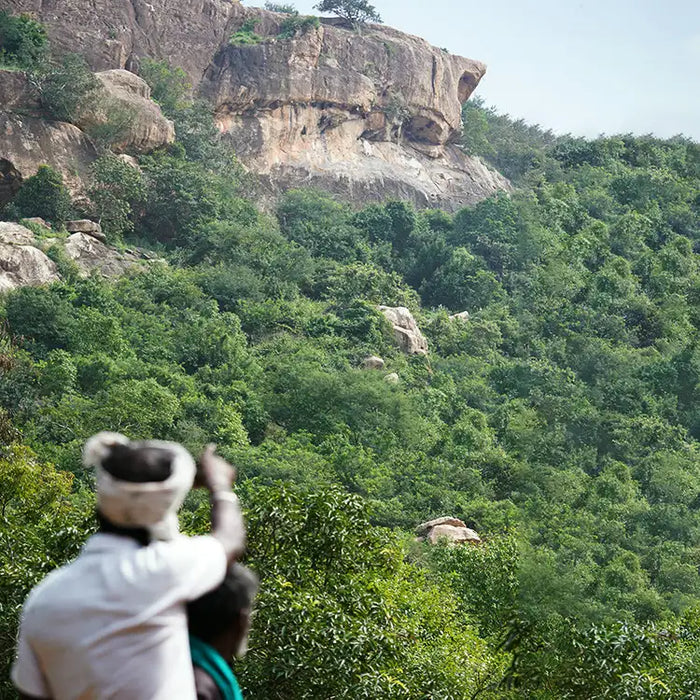
India is home to various honeybee species such as Apis dorsata, Apis cerana indica, Apis florea, and stingless bees, also known as dammer bees, which produce highly medicinal wild honey. These bees forage freely in the forests of the Western Ghats, Sundarbans, Nilgiris, Himalayas, and tribal regions of Central India. Nepal’s Himalayan cliffs are famous for giant honeybees and dangerous cliff-honey harvesting traditions.
Indian environmentalists like ecologists (late) Mr Madhav Gadgil known as “Father of people centric conservation have mentioned the significance of native ecological wisdom for forest preservation. Tribal honey gatherers have extensive knowledge of flowering patterns, bee activity, biodiversity, and ecological harmony.
This article explains the wild honey from historical, scientific, ecological, and nutritional viewpoints. Also, it underlines the importance of supporting Trible honey hunting communities for biodiversity, sustainable livelihoods, and consumer well-being.
Table of Contents
- Introduction
- Table of Contents
- What is Wild Honey?
- What is Raw Honey?
- Understanding the Source and Harvesting of Wild Honey
- Wild Honey Characteristics: Taste, Texture, and Natural Colour
- Health Benefits of Consuming Wild Hone
- Difference between Wild Honey Vs Processed Honey
- Why is it important to support Traditional honey hunters?
- Common myths about wild honey
- Where can I buy wild honey?
- Tips for Finding Best-Quality Wild Honey
- Frequently Asked Questions
- Wild Honey Hunters
\What is Wild Honey?

Wild honey is the purest form of honey collected from bee hives naturally around the wild region, rocky areas, tree hollows & cavities, caves, and mountainous habitats without human intervention. Compared to honey from commercial beehives, wild honey is collected from natural bee hives that collect nectar from a variety of medicinal plants and wildflowers.
In India, wild honey is harvested mainly from the giant rock bee (Apis dorsata), Indian native small bees (Apis cerana indica), and stingless bees found in tropical forests. Tribal communities from Tamil Nadu, Kerala, Karnataka, Chhattisgarh, and Northeast India have practiced honey collection for centuries.
Key Facts of Wild Honey:
- The types of wild honey have been classified based on bee species and floral source.
- Its medicinal benefits can vary depending on the flowers and plants visited by the bees.
- Forest honey was considered special because bees collected nectar from many medicinal herbs, plants, and wild flowers.
Wild honey is different from commercial honey in several ways. It is not processed, only filtered to remove impurities, and is rich in pollen, naturally aromatic, and reflects its region. For example, honey collected from Himalayan forests tastes different from honey collected in the Western Ghats or the wild forest in Rajasthan.
Today, many people have switched to wild honey due to worries about adulteration and poor quality in the commercial honey industry.
What is Raw Honey?
You might be wondering why I’m discussing this question in an article about wild honey. The reason is simple—many people are confused about the terms wild honey and raw honey. Questions such as What is raw honey?, What is wild honey? And what is the difference between raw honey and wild honey? They are very common. Some people even assume that wild honey and raw honey are the same. But that is not true. How? Let us explore,
Even though the two terms are closely related, they have different meanings. The difference lies in where the honey comes from and how it is processed.
Wild honey is honey collected from wild bee colonies that build their hives naturally in forests, cliffs, tree hollows, or other natural locations. It is harvested directly from these wild hives rather than from managed beekeeping farms.
Key point: The term wild honey refers to where the honey comes from.
Raw Honey
Raw honey, also known as “unpasteurized honey,” is honey that is harvested directly from the hive and minimally processed. Unlike commercial honey, also called “pasteurized honey,” it is heavily processed and filtered, but raw honey does not undergo the process of high heat or ultra-filtration. As a result, it retains its natural enzymes, pollen, antioxidants, and other beneficial nutrients.
Key point: The term raw honey refers to how the honey is processed.
Understanding the Source and Harvesting of Wild Honey

Unlike commercial honey farming, wild honey harvesting is a traditional practice that needs skill, experience, and knowledge about nature. It is sourced from different forest regions that contain many medicinal trees, plants, and herbs that provide bees with pollen and nectar. Tribal honey hunters use traditional methods followed by generations to collect natural wild honey from the forests. Here is how the harvesting process works:
Traditional Honey Harvesting has Three Steps:
1. Locating The Hives – Trained honey hunters travel deep into forest regions to identify active bee colonies and observe the bee movement, flowering seasons, and forest ecology.
These hives are mostly located:
- On High cliffs
- On tall trees
- In dense forest areas
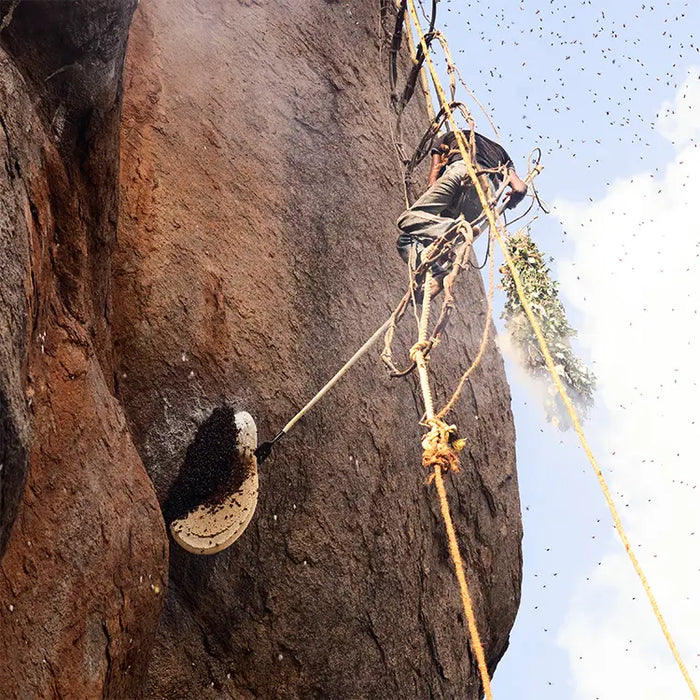
2. Careful Harvesting – Using rope ladders, tribal honey hunters carefully climb on cliffs to collect honey from giant bee colonies. They use smoke from dried leaves and herbs available in that region to calm bees before harvesting the portions of the honeycomb, and leave some part of the comb for the bees to survive.
3. Naturally filter the Honey from the comb after collection – The harvested honeycomb is gently squeezed by hand and filtered through a clean white cloth. This traditional filtering method removes only impurities and preserves the honey’s natural nutrients, enzymes, rich flavour, and natural texture.
The harvesting process usually occurs during specific seasons. Monsoon patterns, temperature, and flowering cycles influence bee activity. Honey collected during medicinal flowering seasons may contain higher antioxidant and medicinal properties.
Indian ethnographic studies show that honey hunting is more than just collecting honey—it requires teamwork, courage, and a deep understanding of nature. Communities often treat bee colonies with respect and avoid excessive collection of honey. This differs from traditional honey harvesting from industrial extraction methods, which primarily focus on maximizing honey production.
Today, Climate change, deforestation, pesticide use, and habitat destruction affect wild bee populations. Therefore, traditional knowledge systems related to honey hunting have become highly valuable.
Wild Honey Characteristics: Taste, Texture, and Natural Colour

Every batch of wild honey is unique because it is influenced by:
- The region where it is harvested
- Seasonal climate and weather conditions
- Forest plants and herbs
- The bees that make the honey
- Wild flowers blooming during that season
As a result, the taste, texture, aroma, and colour of wild honey may vary naturally from one batch to another.
A review titled “Geographical and Seasonal Variations in Honey Composition” highlights how flowers, region, bees, and seasonal changes contribute to the unique taste, color, texture, and aroma of honey.
How Does Wild Honey Taste?
The first thing you will notice about wild honey is that it never tastes exactly the same every time. because bees collect nectar from different wild flowers that bloom in different seasons. Based on that, wild honey can taste mildly sweet, floral, fruity, earthy, or even slightly tangy.
For example, Himalayan honey has herbal notes and a slight bitterness, and the honey from tropical forests has a deep, floral sweetness.
Another perfect example: Palaipoo honey collected from the Western Ghats has a fruity flavour and aroma, but stingless bee honey has a unique sweet and sour flavour – unlike any other honey.
What is the Texture of Wild Honey?
Wild honey’s texture also differs naturally for several reasons, which are:
1. Consistency
Some wild honey varieties are naturally thick because they are unprocessed and not heavily heated. Excessive heating can make honey thinner and can change its natural texture.
2. Crystallization
Some types of wild honey stay liquid for a long time, while others crystallize more quickly. This is a natural process and does not mean the honey spoiled.
3. Natural Nutrients
Because wild honey is usually unheated, it retains natural pollen, nutrients, and live enzymes that contribute to its real texture and nutritional value.
A Real Example of Crystalization:
Karung Kurinji Honey – collected from the nectar of the Karung Kurinji flowers that bloom once every seven years in the Western Ghats. This honey may crystallize naturally over time due to its glucose content.
Note: Crystallization is a natural process and should not be mistaken for adulteration or impurity.
What is the color of wild honey?
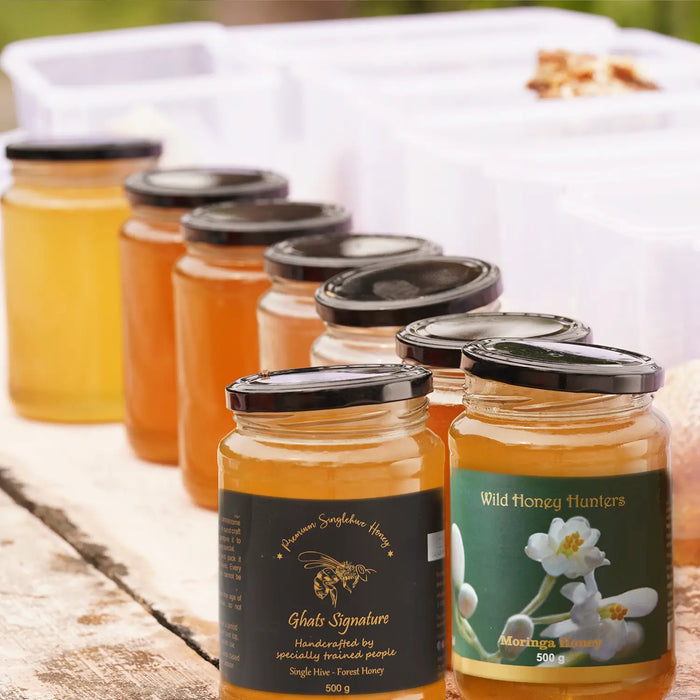
The colour of natural wild honey can range from light golden amber to dark brown. This variation depends on the flowers and plants from which the bees collect nectar. Different floral sources create different colours, which makes each variety of wild honey unique.
Natural wild honey comes in a wide range of colours, including:
Light-Coloured Honey
Light-coloured honey is usually produced when bees collect nectar mainly from light-coloured flowers. A good example is single-floral honey – bees collect nectar specifically from one type of flower.
Golden Yellow Honey
Golden yellow is one of the most common honey colours. It is often produced when bees collect nectar from a variety of wildflowers. A good example is Paalaipoo Honey, a honey with a rich golden yellow shade.
Dark Brown to Black Honey
Some wild honey varieties range from dark brown to almost black in colour. For example, Nagaland Honey and Stingless Bee Honey. These honeys are sourced from dense forests where bees collect nectar on medicinal plants, herbs, and diverse wildflowers that give the honey its darker appearance and distinctive flavour.
What is the aroma of honey?
The aroma of wild honey is one of its most unique characteristics. Wild bees collect nectar from a wide variety of forest flowers, so each honey has its own natural fragrance. Depending on the floral source, the aroma can be floral, fruity, woody, herbal, or earthy. These complex natural aromas are a reflection of the honey’s origin and are difficult to recreate artificially.
Health Benefits of Consuming Wild Hone
Wild honey has been used as a traditional natural remedy for centuries in Ayurveda, Siddha medicine, tribal healing practices, and modern nutrition. But people are still asking the same question: Is it safe to eat wild honey? Let me explain,
In Ayurveda, honey is named as “Yogavahi,” meaning a substance that enhances the medicinal value of herbs. Classical texts such as Charaka Samhita and Ashtanga Hridaya mention honey as a valuable natural remedy used to support digestion, respiratory wellness, wound healing, and overall vitality.
Now, modern research also shows that honey contains antioxidants such as flavonoids and phenolic compounds that help reduce stress and support heart health, healthy aging, immune function, and overall wellness. A review published in the National Library of Medicine indicates that honey has various medicinal properties, such as antioxidant, anti-inflammatory, antibacterial, and immune-supporting activities, and is used as a support for different health conditions.
Today, many people choose wild forest honey for its nutritional value and health benefits. It is widely used both as a natural food and as a topical remedy in various wellness and skincare routines.
Difference between Wild Honey Vs Processed Honey
| Feature | Wild Honey | Processed Honey |
|---|---|---|
| Source | Collected by bees from wild forests, natural habitats, and diverse flowering plants | Usually sourced from managed apiaries and blended with multiple honey batches |
| Processing | Without processed, only filtered to remove impurities | Often heated, heavily filtered, and processed for a uniform appearance |
| Floral Diversity | Nectar comes from a wide variety of medicinal flowers, herbs, and forest plants | Nectar may come from limited floral sources or blended honey sources |
| Nutrient Content | Retains more natural enzymes, pollen, antioxidants, and micronutrients | Processing may reduce some enzymes, pollen, and nutrients |
| Antioxidants | Generally rich in natural antioxidants such as flavonoids and phenolic compounds | Antioxidant levels may be lower depending on processing methods |
| Taste & Aroma | changes based on season and flower source | More uniform and predictable in taste and aroma |
| Colour | Can range from light amber to dark brown depending on floral sources | Usually standardized for consistent colour and appearance |
| Texture | May crystallize naturally over time | Often processed to delay crystallization |
| Traditional Use | Widely used in Ayurveda, Siddha medicine, and tribal healing traditions | Primarily consumed as a sweetener and food ingredient |
| Purity | Often valued for its natural qualities and no processing methods | May undergo blending and commercial processing for mass-market sale |
| Availability | Seasonal and limited due to natural harvesting conditions | Available year-round in large quantities |
Why is it important to support Traditional honey hunters?

Supporting traditional honey hunters is more than just collecting honey. It helps preserve indigenous knowledge, protect biodiversity, and support rural livelihoods.
Preserving Traditional Knowledge
Tribal honey hunters have deep knowledge of ecological and sustainable honey harvesting methods over many generations. They understand:
- Flowering seasons and nectar sources
- Medicinal plants found in forests
- Native bee species and their behavior
Their knowledge plays an important role in maintaining environmental balance and protecting forests.
Protecting Cultural Heritage
Honey hunting is an important part of tribal culture and identity.
These traditions include:
- Traditional honey harvesting techniques
- Rituals and customs connected to honey collection
- Skills passed down from one generation to the next
Preserving these practices helps keep cultural heritage alive for future generations.
Supporting Environmental Conservation
The survival of wild bees is closely connected to healthy ecosystems.
- Bees are essential pollinators for forests and agriculture
- Traditional honey hunters depend on healthy forests for their livelihood
- As a result, they have a strong interest in protecting natural habitats
Supporting honey hunters contributes to the conservation of forests and biodiversity.
Supporting Traditional Communities
Many environmental experts believe that tribal communities play an important role in biodiversity protection.
These communities often:
- Lives in harmony with nature
- Use natural resources responsibly
- Follow sustainable harvesting practices
Addressing Modern Environmental Challenges
Climate change and deforestation are affecting native bee habitats across South Asia.
By supporting traditional honey hunters, we can:
- Encourage forest preservation
- Protect native bee populations
- Preserve biodiversity
- Promote livelihoods that value forests as living ecosystems rather than just resources
Common myths about wild honey
There are many myths and misconceptions regarding wild honey. Let’s look at some of the most common myths and understand the real truth behind them.
Myth 1: Crystallized Honey Is Fake
One common myth that always confuses people is that crystallized honey is fake. In reality, crystallization is a completely natural process and is a sign that the honey is pure and unprocessed.
Honey is known as a “supersaturated sugar solution” because it contains natural sugars, mainly glucose and fructose. Over time, glucose naturally separates from the water content in honey and forms solid crystals. This process is called crystallization.
Raw forest honey can crystallize faster because it contains natural pollen, enzymes, and other micro particles that help a lot with crystal formation. The process of crystallization can also vary depending on the flower’s source, storage temperature, and glucose content of the honey.
Crystallization is a natural characteristic of pure honey and does not mean that the honey has spoiled or lost its quality. In fact, it is a sign that the honey is raw, unprocessed, and in its natural state.
Can I Eat Crystallized Honey?
Yes, absolutely. Crystallized honey is completely safe to eat and contains its natural flavor, nutrients, and beneficial properties.
How to Decrystallize Honey?
Simply placing the honey jar in warm water can help restore its liquid consistency if desired.
Myth 2: Ants and Dogs Won’t Eat Pure Honey
Another common myth is that ants and dogs will not eat pure honey. Many people believe that if ants are attracted to honey or a dog enjoys eating it, the honey must be adulterated. But that is not true.
Honey contains natural sugars that can attract ants and other insects. In the same way, many dogs also consume and enjoy honey.
To understand this misconception more clearly, the YouTube channel Wild Honey Hunters has shared a video showing ants and animals consuming pure wild honey without hesitation.
Myth 3: All Honey Harvesting Harms Bees
There is also a misconception that all honey harvesting harms bees. But, traditional honey hunters harvest honey carefully using traditional methods without harming bees, and leaving enough honey for bees to survive and rebuild colonies.
Myth 4: DIY Tests Can Accurately Show Honey Purity
DIY methods like water test, fire test, and paper test are enough to find the purity and authenticity of honey – that’s a big NO! Proper lab tests are the trusted source to find the purity.
Myth 5: Wild Honey Never Spoils
Some people think wild honey never spoils. Honey has excellent preservation properties, but poor storage can affect its flavours and quality over time.
To maintain its natural goodness, honey should be stored in a clean, airtight container at room temperature and away from direct sunlight.
Where can I buy wild honey?
India’s Western Ghats and Eastern Ghats, the Himalayan regions, and Indian forests are where we find a lot of forest honey.
In Nepal, people have been hunting honey in the cliffs for a long time, and this practice is well known around the world.
How to Identify Authentic Wild Honey?
When purchasing wild honey, consumers should look for:
- Transparent information about the source of the honey
- Details about harvesting methods and honey-hunting communities
- Quality certifications and laboratory testing reports
- Genuine customer reviews and testimonials
Authentic wild honey is typically more expensive because it is collected through labor-intensive and seasonal harvesting methods that require skill, experience, and careful handling.
Consumers should avoid suspiciously low-priced products claiming to be wild honey. Authentic forest honey requires major human skill, risk, and ecological knowledge.
Wild Honey Hunters sources honey from multiple regions across India and Nepal through a partnership with traditional honey-hunting communities.
Tips for Finding Best-Quality Wild Honey
Choosing genuine wild honey requires more than simply reading the label. Consumers should carefully analyze and question the authenticity of honey quality before purchase.
Authentic wild honey usually contains natural aroma, floral differences, and slight variations in taste, colour, and texture. Unprocessed raw forest honey preserves pollen and natural compounds like propolis.
Check Source Transparency
A trustworthy honey brand should provide clear information about:
- Collection regions
- Honey-hunting communities
- Harvesting practices
- Processing methods
Transparency helps consumers understand where their honey comes from and how it is collected.
Don’t Mistake Crystallization for Adulteration
Crystallization should not be mistaken for impurity. It often indicates genuine raw honey.
Consider Packaging
Glass packaging is generally preferred because it preserves taste and quality better than certain plastics.
Experience Honey in Its Purest Form
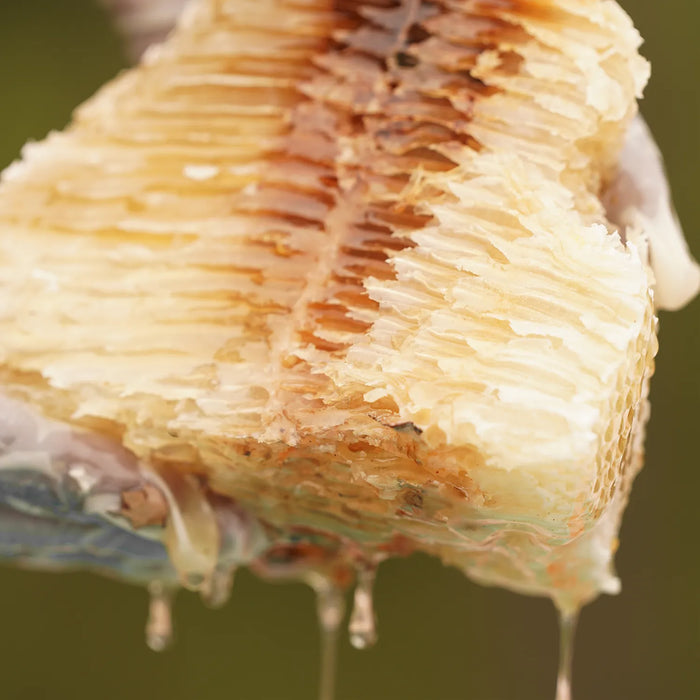
Eating raw honeycombs is one of the best ways to experience wild honey in its most natural state.
Frequently Asked Questions
Conclusion
Wild honey is more than just a natural sweetener—it is a product of wild forests, native bees, and the traditional knowledge of honey-hunting communities. From its unique flavors and natural profiles to its cultural and ecological significance, wild honey has an authentic connection to nature.
Understanding how wild honey is harvested, the meaning of wild and raw honey, understanding common myths, and knowing how to identify genuine products can help consumers make perfect choices. By choosing authentic, ethically sourced wild honey, you not only enjoy a natural and wholesome food but also support biodiversity conservation, traditional livelihoods, and sustainable forest ecosystems.
At Wild Honey Hunters, we are committed to bringing you pure wild honey collected by experienced traditional honey hunters from the forests of India and Nepal. Every jar reflects nature’s richness, the skill of honey hunters, and our dedication to preserving this remarkable heritage for future generations.
If you are still having the same question, is it safe to eat Wild Honey? Try pure, authentic wild honey from Wild Honey Hunters for a week and experience its natural goodness for yourself.
Explore Wild Forest Honey Collections 👉 https://www.wildhoneyhunters.com/products/

Wild Honey Hunters
“Ghats Honey is a unit of Wild Honey Hunters, offering 100% natural wild honey with all nutrients intact. We specialize in pure forest honey sourced from different bee species and seasonal flowering regions. Our collection includes raw wild honey, stingless bee honey, and rare Kurinji honey, each unique to its natural nectar origin.”